
What is Tarot – and why can it help us?


Tarot is more than fortune-telling. More than esotericism. And above all: more than what many people have heard about it so far.
When people hear the word "Tarot," certain ideas often immediately come to mind: card readings, fortune-telling, fate, hocus-pocus, or questions about what the future holds.
For this reason, some people are fundamentally skeptical of Tarot. Others associate it with things that conflict with their personal beliefs—such as religion or the Bible. And then there are those who simply cannot imagine what value Tarot might offer.
I can understand that.
After all, if you view Tarot merely as a method for predicting the future using cards, it is indeed difficult to see why it might be relevant to personal development.
But Tarot can be understood and used in a completely different way.
Tarot is not a pigeonhole.
A Tarot card doesn’t simply say, “This is you.”
Nor does it decide, “This is what will happen.”
Instead, Tarot can open up a space where we can examine our current life situation.
After all, we humans do not think and feel exclusively in words.
Sometimes we know full well that something is stirring within us, yet we cannot explain what it is.
We sense a change.
A longing.
A fear.
An inner conflict.
We may know that we need to make a decision, yet find no access to what we truly want.
Some things are hard to put into words.
Images and symbols can offer a different way of accessing these things.
A Tarot card can spark a thought, stir a memory, touch an emotion, or open up a new perspective.
You might see a card and think:
“That is exactly what I’m dealing with right now.”
Or perhaps you think:
“No, not at all.”
Both reactions can be interesting.
For our reaction to a symbol can also tell us something about our own perception.
Tarot as a Symbolic Language

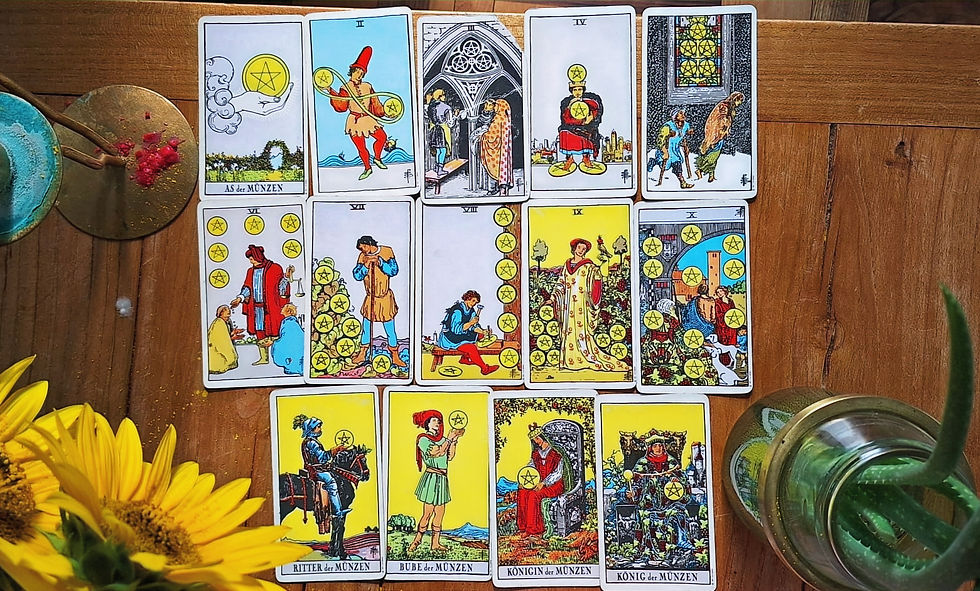
Tarot consists of images.
And images can speak a different language than mere words.
The cards contain symbols, figures, colors, situations, and archetypal motifs. They tell of themes that have always occupied the human mind: love, loss, new beginnings, fear, courage, change, loneliness, hope, power, decisions, and transformation.
This is where the connection to Carl Gustav Jung becomes interesting.
The Swiss psychiatrist and psychotherapist C. G. Jung engaged deeply with symbols, dreams, myths, and archetypes. Simply put, archetypes describe fundamental psychological patterns and images that recur across different cultures and human experiences.

Jung also delved deeply into alchemy, interpreting it—among other things—as a symbolic expression of psychological transformation.
We find numerous images of transformation in the Tarot as well.
Death and rebirth.
Destruction and new beginnings.
Letting go and growth.
Chaos and order.
The Fool’s journey through the Major Arcana, for instance, can be read as a symbolic voyage through various human experiences.
Did C. G. Jung believe in Tarot?
An important distinction must be made here.
It would be incorrect to claim that Jung viewed the Tarot as a scientifically proven method for predicting the future.
However, Jung did engage with the Tarot—and specifically with the symbolic and archetypal connections found within it. His writings demonstrate his keen interest in symbols, synchronicity, alchemy, and psychological transformation.
The connection between Jungian psychology and the Tarot is therefore certainly interesting—but it should not be overstated.
The Tarot is not a psychological method developed by Jung.
Nor is the Tarot a scientifically validated method for predicting future events.
Rather, the Tarot becomes interesting when we consider the impact of symbols, images, associations, and self-reflection.
What happens when we look at a tarot card?

Imagine drawing a card.
On it, for example, you see a person standing alone on a mountain.
What does this image evoke in you?
Perhaps you think of loneliness.
Perhaps of freedom.
Perhaps of withdrawal.
Perhaps of a phase in your life when you needed some distance from other people.
Perhaps the card reminds you of a decision you currently have to make.
The card itself did not "invent" your thoughts.
It has provided a prompt for you to reflect on.
That is an important distinction.
Tarot doesn't have to read something *into* you.
It can help you draw something *out* of yourself.
Does Tarot show the future?
For me, Tarot is not about a fixed prediction of the future.
Instead, a Tarot reading can be understood as a snapshot of the moment.
It can symbolically represent the current situation, underlying themes, potential developments, or various possible courses of action.
However, our future is not independent of the decisions we make.
We shape our situation through our thoughts, actions, boundaries, decisions, and our willingness to make changes.
That is why a Tarot reading should never imply:
"The cards said this is how it will happen, so it must be so."
I find it far more helpful to ask:
"If I continue as I have been—where might this path lead?"
And:
"What can I do to change myself / habbits?"
For ultimately, it is not the cards that determine our lives.
We do.
Tarot can offer a different perspective.
When we are in the midst of a difficult situation ourselves, we often see only a small part of the picture.
Our fears, expectations, and past experiences shape our perception.
A tarot reading can help us gain some distance for a moment.
Not because the cards provide an absolute truth.
But because they offer a different perspective.
A tarot reader can ask questions, highlight connections, and put into words thoughts that you might not yet have been able to articulate yourself.
And sometimes, that alone brings incredible relief.
After all, we don’t always have to figure everything out on our own.
When Words Fail

Sometimes we feel a great deal, yet can barely put into words what is actually happening inside us.
Perhaps we are facing a decision, going through a breakup, or at a professional turning point—or we simply sense: "Something in my life wants to change."
Tarot can help make this inner movement visible—not as a diagnosis or therapy, but as an impetus for self-reflection.
Tarot as a complement to other experiences

Even after yoga, meditation, massage, or breathwork, tarot can create a valuable moment of reflection.
What touched me? What do I want to take away from this experience? What am I ready to let go of?
The cards do not need to "explain" anything. They can help you stay more consciously connected to your experience and allow new thoughts to emerge.
Trust develops over time.
Many people carry personal issues with them but do not wish to open up to a stranger right away. That is understandable.
That is precisely why I want to use my Instagram channel https://www.instagram.com/bellastarotberatung/ to create a space where you can get to know me and my work—my approach to Tarot, my working style, and what Bella’s Tarot Consulting stands for.
For me, Tarot is not about taking control of someone’s life out of their hands.
Tarot is not hocus-pocus – but neither is it science.
I do not want to convince anyone that Tarot "has to work." You do not need to believe in magical powers, and you are free to view Tarot critically.
For me, the strength of Tarot lies in the fact that images, symbols, and a consciously guided conversation can create a space for new perspectives and self-reflection.
Tarot and Religion
Tarot is sometimes hastily associated with fortune-telling or ideas incompatible with one's own religious beliefs.
I believe it is important not to pigeonhole Tarot. Not every Tarot reading is fortune-telling, and not every Tarot reader operates from the same worldview.
You don’t have to believe in Tarot yourself or use it personally to still engage with it openly and understand why it can be valuable to others.
Tarot is not a substitute for psychotherapy.
A Tarot consultation is not a substitute for psychotherapy or for medical or psychiatric treatment.
However, it can serve as a complementary tool for self-reflection—alongside many other approaches such as journaling, meditation, yoga, coaching, bodywork, or creative methods.
What helps one person does not necessarily work for another.
The cards do not decide your life.
The cards don't have the final say. You do.
Tarot can act as a mirror, raise questions, reveal a blind spot, or show a situation from a new perspective.
But no card can make a decision for you or determine your future.
We are constantly changing. We grow, we doubt, we let go, and we start anew.
Tarot can be a tool for becoming more consciously aware of these changes.
Perhaps that is why the most important question isn't:
"What will happen?"
But rather:
"What do I want to do with what is happening right now?"
For that is precisely where I see the strength of Tarot: not in dictating our lives for us, but in supporting us as we view our own lives more consciously.
The cards do not give us back our power—they remind us that it was with us all along. <3
Comments